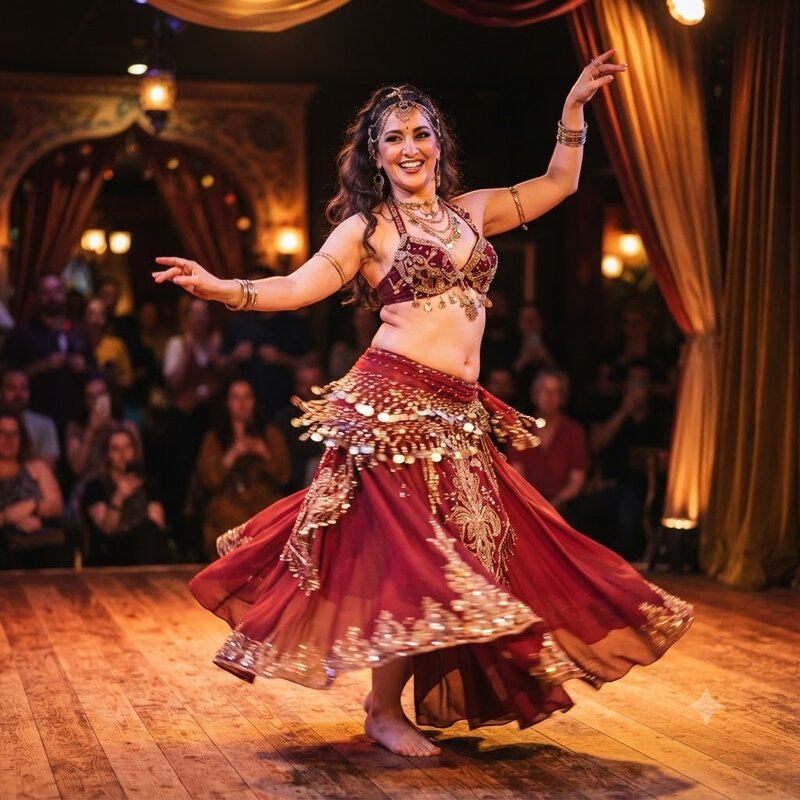
Keep your knees softly bent rather than locked straight throughout, since locked knees make isolating your hips nearly impossible and put unnecessary strain on your lower back. Practice isolating your hips and ribcage separately before combining them with arm movements, since trying to learn everything at once usually causes the whole body to move together as one stiff block instead of in distinct layers. Start slowly with a mirror or a filmed recording of yourself, since belly dance relies on small, precise isolations that are easy to blur together at speed and hard to self-correct without visual feedback. Keep your core gently engaged throughout, since a relaxed core makes hip movements look sloppy and offers no support for the sharper, more controlled moves used in faster songs. Wear a hip scarf with coins or beads during practice, since the sound and movement of the scarf gives you immediate feedback on whether your hip isolations are sharp and controlled or vague and imprecise. Learn the basic Egyptian and Turkish style differences before mixing movements from both, since blending techniques without understanding their distinct postures and rhythms early on can create habits that are hard to unlearn later.