Suggest a new activity

This site is protected by reCAPTCHA and the Google Privacy Policy and Terms of Service apply.

Report a bug

Optional, 1 image up to 5 MB.

This site is protected by reCAPTCHA and the Google Privacy Policy and Terms of Service apply.

Report an error in this activity

This site is protected by reCAPTCHA and the Google Privacy Policy and Terms of Service apply.

Moon Phase Journal

Moon Phase Journal

Min number of participants 1
Age 5+ yrs.
Safety support by adult Not required
Min duration 5 min.
Cost None (Free)
Environment Outdoor

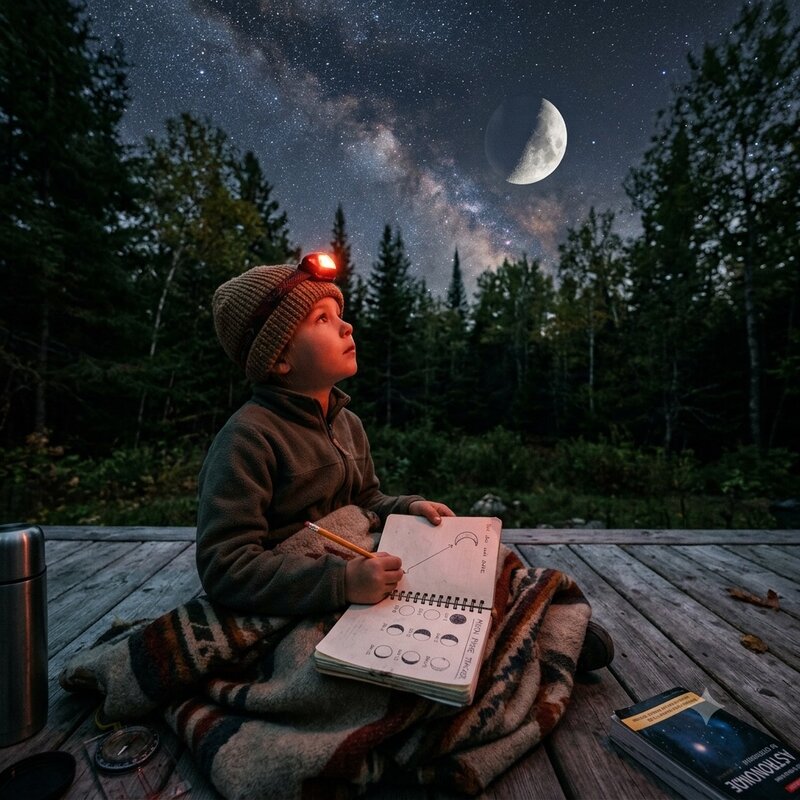
Each night draw the moon's shape in a small notebook and track its waxing and waning over a month — a simple, beautiful sky-watching habit that connects children to the rhythms of the natural world.


The Essentials

Steps

  1. Check a moon phase calendar or app to know roughly when to observe, since the moon rises and sets at different times depending on its phase.
  2. Find a spot with a clear view of the sky, ideally away from bright artificial lights, to see the moon's details more clearly.
  3. Note the date, time, and current phase name (new, waxing crescent, first quarter, and so on) at the top of each journal entry.
  4. Sketch or photograph the moon's shape and any visible surface features, like maria (dark patches) or craters near the terminator line.
  5. Record additional details such as weather conditions, moon's position in the sky, and your general mood or observations, since these add context to your entries over time.
  6. Repeat regularly (daily or every few days) over a full lunar cycle of about 29.5 days to build a complete record of one cycle.

Tips

  • Use binoculars if you have them, since even basic ones reveal craters and maria far more clearly than the naked eye.
  • Observe around the same time each day if possible, since consistent timing makes it easier to track how the moon's position shifts night to night.
  • Photograph the moon with a smartphone by holding it steady against binoculars or a telescope eyepiece for a simple, effective technique.
  • Look for the terminator line (the boundary between light and shadow), since surface details are most visible there due to dramatic shadows cast by craters and mountains.
  • Keep your journal in a consistent format each time, since a standardized layout makes it much easier to compare entries and spot patterns later.
Activities

Similar activities (see all)

Report an error in this activity

This site is protected by reCAPTCHA and the Google Privacy Policy and Terms of Service apply.

DIY Rain Gauge

DIY Rain Gauge

Cut a plastic bottle, mark a measurement scale with a ruler, and set it in the garden — then read it each morning after rain and log the results in a weather journal. A tiny science project with big results.

Report an error in this activity

This site is protected by reCAPTCHA and the Google Privacy Policy and Terms of Service apply.

Tea Ceremony

Tea Ceremony

The Japanese chado ritual of preparing and serving matcha with meditative care — whisking powdered tea in a raku bowl, observing the seasonal scroll, and sharing a quiet, present moment with your guest.

Report an error in this activity

This site is protected by reCAPTCHA and the Google Privacy Policy and Terms of Service apply.

Mysterium

Mysterium

One player is a silent ghost sending cryptic dream-card visions to psychic investigators who must identify the correct suspect, location, and weapon that led to the ghost's murder.