Suggest a new activity

This site is protected by reCAPTCHA and the Google Privacy Policy and Terms of Service apply.

Report a bug

Optional, 1 image up to 5 MB.

This site is protected by reCAPTCHA and the Google Privacy Policy and Terms of Service apply.

Report an error in this activity

This site is protected by reCAPTCHA and the Google Privacy Policy and Terms of Service apply.

Model Railways

Model Railways

Min number of participants 1
Age 8+ yrs.
Safety support by adult Not required
Min duration 30 min.
Cost Medium
Environment Indoor / Outdoor

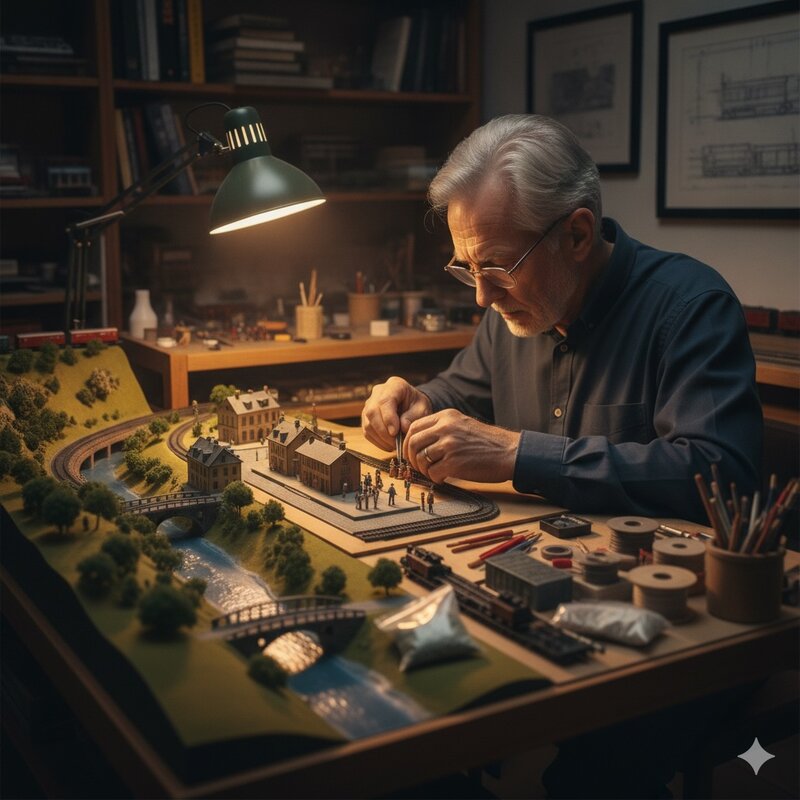
Build a miniature railway system at HO, N, or OO scale — laying track, wiring points and signals, landscaping the baseboard with plaster terrain and model trees, and operating locomotives that run on a DCC digital control system — model railways combine carpentry, electronics, painting, and logistics into an absorbing lifelong hobby.


The Essentials

Steps

  1. Choose a scale (like HO, N, or O) based on your available space, since scale determines both the physical size and the number of details available for locomotives and scenery.
  2. Plan your track layout on paper first, considering curve radii, since tight curves that look fine on paper may not work with your specific locomotives and rolling stock.
  3. Build or acquire a sturdy benchwork base before laying track, since an unstable foundation causes derailments and makes future adjustments difficult.
  4. Lay and test track thoroughly before ballasting or fixing it permanently, running trains over every section to check for gaps, kinks, or electrical issues.
  5. Wire your layout methodically, using a wiring diagram if working with multiple blocks or accessories, since retrofitting wiring later is far more difficult than planning it upfront.
  6. Add scenery, buildings, and landscaping last, once the track and wiring are confirmed reliable, since scenery work is much harder to redo around finished track.

Tips

  • Clean track regularly with an appropriate track cleaner, since dirty rails are the most common cause of stalling or erratic locomotive behavior.
  • Test each new locomotive on a simple test track before running it on your full layout, to confirm it runs smoothly and matches your other rolling stock's coupler height.
  • Join a local model railway club if possible, since experienced members can help troubleshoot wiring issues and offer layout design advice specific to your scale.
  • Keep detailed records of your wiring and track plan, since even a small layout becomes hard to remember accurately after a few months.
  • Budget for scenery materials as carefully as for track and locomotives, since landscaping, ballast, and structures often end up costing more than the trains themselves.
Activities

Similar activities (see all)

Report an error in this activity

This site is protected by reCAPTCHA and the Google Privacy Policy and Terms of Service apply.

Travel Journaling

Travel Journaling

Pulling out a notebook to jot down trip expectations, gate-side observations, or a packing-day recap — a quiet, reflective habit that turns layover boredom into a keepsake of the journey.

Report an error in this activity

This site is protected by reCAPTCHA and the Google Privacy Policy and Terms of Service apply.

Family Cooking Challenge

Family Cooking Challenge

Pick a theme — Mexican, Japanese, five ingredients — assign roles, set a timer, and cook together under friendly competition. A fun, educational kitchen game that ends with a meal you made as a team.

Report an error in this activity

This site is protected by reCAPTCHA and the Google Privacy Policy and Terms of Service apply.

Colour Mixing Experiments

Colour Mixing Experiments

Fill glasses with water, add food colouring, and mix combinations to discover new hues — a simple kitchen science activity that teaches children colour theory and the joy of discovery.